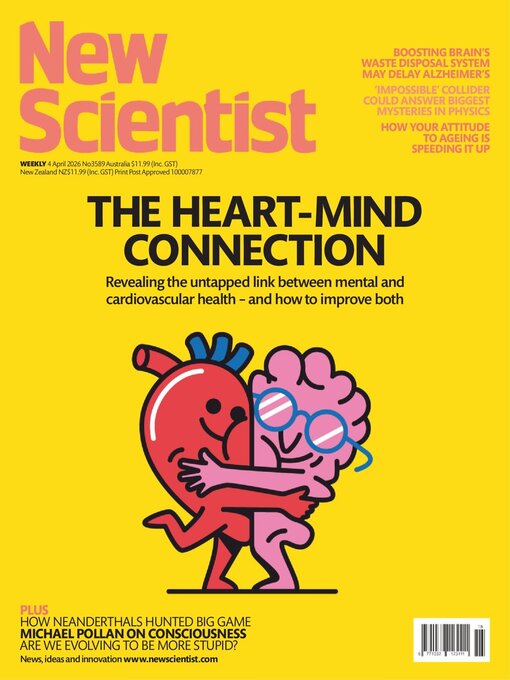
 Apr 04 2026
 Mar 28 2026
 Mar 21 2026
 Mar 14 2026
 Mar 07 2026
 Feb 28 2026
 Feb 21 2026
 Feb 14 2026
 Feb 07 2026
 Jan 31 2026
 Jan 24 2026
 Jan 17 2026
 Jan 10 2026
 Jan 03 2026
 Dec 27 2025
 13/20 December 2025
 Dec 06 2025
 Nov 29 2025
 Nov 22 2025
 Nov 15 2025
 Nov 08 2025
 Nov 01 2025
 Oct 25 2025
 Oct 18 2025
New Scientist covers the latest developments in science and technology that will impact your world. New Scientist employs and commissions the best writers in their fields from all over the world. Our editorial team provide cutting-edge news, award-winning features and reports, written in concise and clear language that puts discoveries and advances in the context of everyday life today and in the future.
The war on food • We’re about to learn the hard way that we essentially eat fossil fuels
New Scientist Australian Edition
Cystitis or tooth decay could raise dementia risk
Drugs rid brain of Alzheimer’s proteins • Treatment that strengthens the brain’s ability to clean itself could delay the onset of Alzheimer’s disease by up to seven years, finds Carissa Wong
Sperm whales help each other give birth
Magnets may offer best asteroid defence
A quantum way to take the temperature
AI data centres could warm surrounding areas by up to 9.1°C
Male G-spot isn’t where we thought it was
Genetic clues tell the story of Neanderthals’ decline
Going on the hunt with Neanderthals • A set of elephant bones and a wooden spear found in Germany in 1948 are telling us more about the big-game-hunting abilities of our ancient human relatives, reports Emily H. Wilson
Turin Shroud has just become even more mysterious
Our friendship with dogs is a longer tale than we thought
Computer program spots flaw in physics paper for first time
Cloning has an unexpected problem • A study has shown cloning doesn’t produce perfect copies, with big implications for farming and de-extinction efforts, discovers Michael Le Page
Global food prices are rising • The real-terms cost of food is already nearing levels seen after the 1970s energy crisis, but the Iran war could cause it to rise even higher
Food shock is inevitable due to Iran war • Even if the conflict were to end today, disruption to fertiliser and pesticide production will lead to rising food prices, reports Michael Le Page
Rewriting Earth’s origin story • Computer simulations are making us think again about how our solar system’s rocky planets – Mercury, Venus, Earth and Mars – first formed, discovers Leah Crane
Disintegrating comet could reveal solar system’s secrets
We may have just discovered the closest ancestor of all apes
Fig tree canopy gives variety of animals a loo with a view
Is this the cause of Antarctic sea ice loss? • Sea ice extent in Antarctica has been declining sharply in recent years, and we are now starting to realise the role that the ocean has played in this abrupt shift, finds Alec Luhn
A negative attitude towards ageing is making you age faster • We know a person’s outlook can have a huge effect on their health. Graham Lawton looks at how you can change yours to age better
Are we evolving to be more stupid? • Humans have a high genetic mutation rate, which some say is making us less intelligent – but Michael Le Page finds these mutations may not be so bad after all
Amazon efforts
Three more great reads on sex and evolution
Of sex and nature • Ducks with corkscrew penises, fish changing sex – what do we really know about sex and reproduction on Earth? Less than we think, finds Elle Hunt
New Scientist recommends
“It becomes an obsession” • A psychedelic experience set author Michael Pollan on a quest to understand consciousness. He tells Olivia Goldhill what he learned – and how it changed him
Your letters
Look who’s talking • The deep links between your heart and brain have a profound effect on your health, finds Abigail Hodder
The impossible collider • Once dismissed as preposterous, the muon collider could answer...